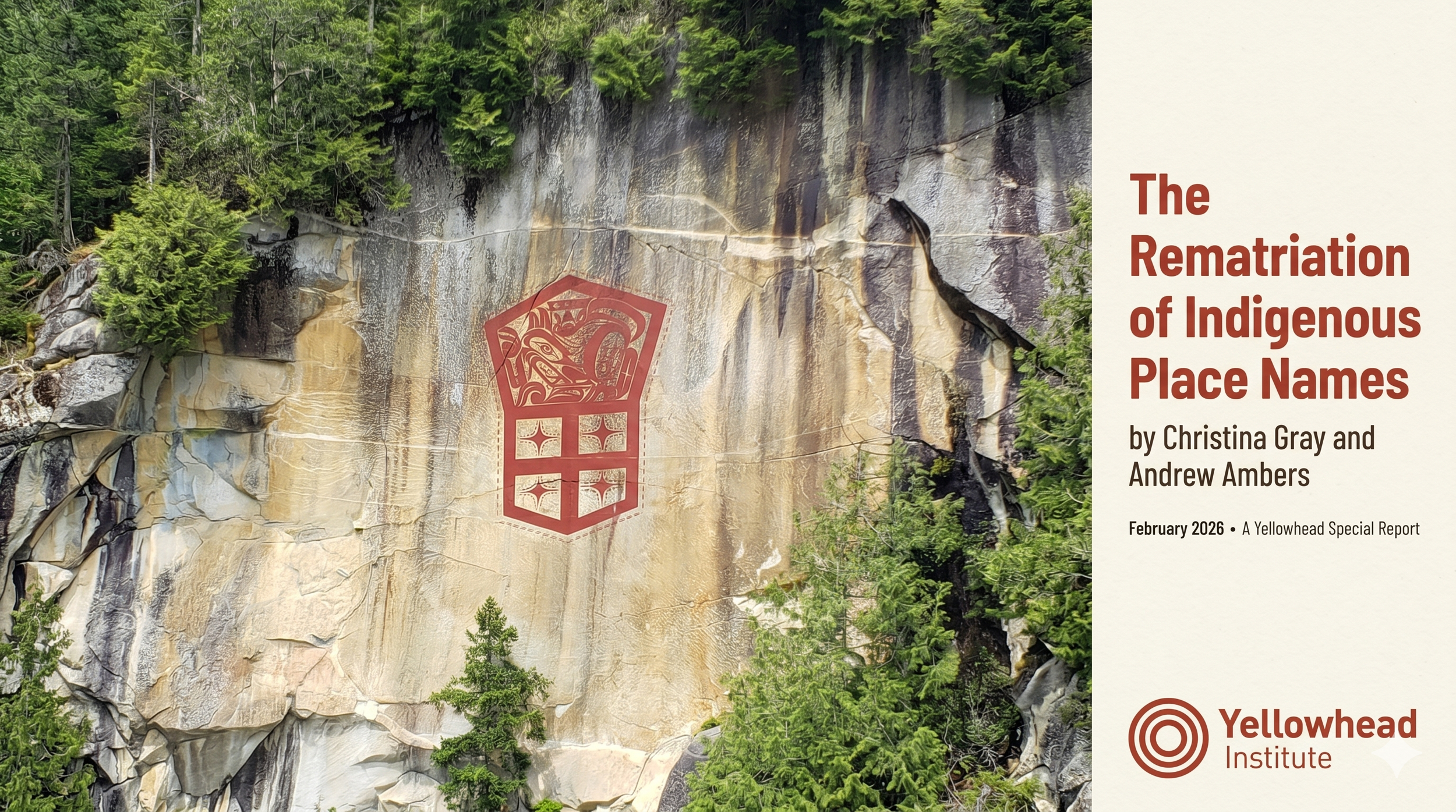
In our Yellowhead Institute Special Report, The Rematriation of Indigenous Place Names, co-author Andrew Ambers (Kwakwaka’wakw, ‘Namgis and Ma’amtagila First Nations) and I argue that Indigenous place names are not symbolic gestures. They are expressions of Indigenous law and sovereignty — corrective tools that can restore right relationships when colonial systems have distorted them.
More Than Renaming
Our report draws on practices shared among Dene, Ts’msyen, and Kwakwaka’wakw communities to frame rematriation through three interconnected legal processes: truth-telling, gifting, and witnessing.
Witnessing is a relational responsibility — a commitment to record, validate, and recall important legal and political events within extended kinship networks. Truth-telling is not just a principle but an obligation: to advance accurate accounts of history no matter how much colonial narratives attempt to displace them. And gifting — when an Indigenous Nation places its language on the land through a naming ceremony — activates shared responsibilities among governments, institutions, and the public to honour the laws and histories embedded in that name.
Together, these practices do more than change a street sign. They reawaken Indigenous laws on the territory, uplift the authority of matriarchs and Two-Spirit leaders, and move renaming from symbolic gesture to meaningful act of self-determination.
Rematriation in Practice
Our report is grounded in real examples of this work already underway:
In Winnipeg, three streets previously named after Bishop Vital-Justin Grandin — a key figure in the Indian Residential School system — were renamed through an Indigenous Knowledge Naming Circle of Elders, Survivors, Knowledge Keepers, and Youth. The new names — including Abinojii Mikanah (“children’s way” in Ojibwe) and Taapweewin Way (“Truth” in Michif) — inscribe responsibility and memory directly onto the land.
In Edmonton, seventeen Indigenous matriarchs known as iyiniw iskwewak wihtwâwin guided the renaming of twelve municipal wards in six weeks, gifting names in Cree, Blackfoot, Mohawk, Inuktun, and more — each one carrying distinct histories of people, place, and politics.
In Vancouver, the xʷməθkʷəy̓əm/Musqueam Nation gifted the city a new name to replace Trutch Street, hosting a formal witnessing ceremony and activating legal responsibilities between the Nation and the City.
A Corrective, Not an Erasure
One of the most important arguments we make is pushing back against the framing that renaming erases history. We argue the opposite: replacing colonial place names with Indigenous ones corrects history. It makes visible what colonialism attempted to disappear — the matriarchs, the legal orders, the languages, and the truths of the land.
As of 2025, fifteen official Canadian geographical names still contain a derogatory slur for Indigenous women. These names are not neutral — they are acts of ongoing violence against matriarchal authority and Indigenous women’s relationships to their territories.
Calls to Action
We close with direct calls for governments and institutions:
Meaningfully support the rebuilding of Indigenous governance systems and rematriation processes — with sustained, long-term institutional commitment.
Establish a working group with regional and national representation to guide naming protocols at the municipal, provincial, and federal levels.
Support the plurality of Indigenous legal orders and languages in all decision-making around rematriation.
Read the full report at yellowheadinstitute.org
You can download the full Special Report, along with our accompanying legal factsheet and partial map infographic, directly through the Yellowhead Institute website.